
The Princess’s Nose

The Princess’s Nose

a children’s story by Nick Morgan (after Gogol)

nose and no nose

Once upon a time there was a Princess.  Her name was Rose.  She was famous all over the world because everyone thought she was the most beautiful woman anywhere, ever.  Musicians sang songs about her beauty.  Poets wrote sonnets about her.  Sculptors and artists drove themselves insane trying to capture her beauty in works of art, as nothing they made, nothing they painted, nothing they drew could ever quite match the beauty of Princess Rose herself.

But despite her great beauty, Princess Rose was not happy.  At least three times every day she looked at herself in a large, golden mirror in her room.  And every time she looked at herself, she stared at her face in dismay.  For, while everyone else only saw beauty in her face, she could only see her nose.

“I hate my nose,” she used to say,

“it’s far too long,

it’s far too pointy,

it’s far too small at the top,

it’s far too bulbous at the bottom,

and its nostrils are far too big and yucky.”


One night as the Princess slept, her nose decided it had had enough of all this abuse.  At bedtime, Princess Rose had spent even longer than usual staring and prodding at her poor nose.  She’d called it all sorts of horrid names, like Scummy Sniffer, the Terrible Trunk and Super Schnozzle. The nose was upset. Maybe it really was ugly. Perhaps Princess Rose would be better off without it.


The nose decided it would go and seek its fortune by itself out in the big, wide world.  So it hopped off the Princess’s face and ran away, out of the castle, all the way through the castle grounds and off into the Royal Forest.


***


The following morning Princess Rose woke up and, as usual, went over to her large, golden mirror.  She hoped her nose wouldn’t look too horrid and bulbous this morning.  Still half-asleep she opened her eyes to look at herself in the mirror.  Hmm…..  Something was wrong with what she saw, but what?

Her hair was still looking lovely (she never suffered from bed-head hair) and its lovely thick, red locks cascaded over her shoulders.

Her dazzling green eyes were all sparkly and framed by her lovely, long eyelashes.

Her eyebrows were neat and even.

Her cheeks and chin were still elfin and elegant (her cheekbones were the envy of supermodels everywhere).

Her lips were like a small, precious rosebud.

Her nose… oh no!

Where was her nose?


In the middle of the Princess’s face, where her nose should have been was a flat, empty space. Her nose was gone!


In a panic, Princess Rose raised the alarm and very soon the whole castle was being turned upside down as every servant, every soldier and even the King and Queen themselves searched high and low for the Princess’s missing nose.


***


Meanwhile, the nose had been having a miserable time in the forest. It had made a bed for itself among the roots of an old oak tree, covering itself in leaves and acorns it had found there. However, before dawn it had been woken up very rudely by an angry squirrel who’d thought that the nose was trying to steal from her secret store of acorns.  The nose wandered through the forest all alone, lost and with no idea what to do next.  Whatever would become of it, a nose all alone in the world, it wondered?

Suddenly the nose heard a strange noise coming from not very far away in the forest, and so it wandered over to investigate.  As it got closer it was sure it could hear voices.  It found itself in a broad, green clearing.  A man and a woman were at the other side of it, and the woman was holding a film camera on her shoulder.  It was pointing at the man who was talking into it:

“…and we are here in the Royal Forest where we’re hoping to catch a glimpse of some of the many creatures who live here. If we’re lucky, maybe we’ll see some…. er….”

The man’s voice trailed off as he caught sight of the nose.

“Elaine, what on earth is that?” he asked, pointing to the nose.

“How amazing!” said Elaine, “It’s a nose, Rob, and what a beautiful one it is too. I wonder what it’s doing out here.”

Elaine and Rob went over to the nose to introduce themselves and the three of them soon became friends.  It turned out that Rob and Elaine were making a wildlife documentary for TV all about the Royal Forest, but as soon as they had seen the nose they forgot all about that.  They thought the nose was so unusual, so beautiful, so interesting and so elegant that they decided to make a programme about the nose instead.


***


The following weeks and months were an amazing time for the nose.  The documentary which Elaine and Rob had made about the nose was so popular that it was shown on the telly every night for a month.  Everyone was fascinated by the beautiful nose.  Newspaper cameramen followed the nose wherever it went.  The nose appeared on chat shows.  It was invited to be a celebrity guest on quiz shows.  Fashion designers made special hats and jewellery for the nose to wear.  The nose was seen in restaurants and at movie premieres with famous film stars. The nose even won Celebrity Big Brother by a landslide. It was a superstar.


***


The only place in the kingdom not to be gripped by this media frenzy over the nose was the Royal Palace. They were still in the midst of their very own nose frenzy, still searching frantically for it, but everyone in the palace was sworn to secrecy.  If the news ever got out that the Kingdom’s most beautiful treasure, Princess Rose, was going around without a nose, the King and Queen could simply not bear the shame.  So obsessed was the Royal household with their search for the lost nose that they hadn’t paid attention to anything else which was happening in their Kingdom.  However, the quest for the nose would have to stop for at least one day.  Every year on the Queen’s birthday the King and Queen threw a party in the Grand Hall of the Royal Palace.  The great day was coming up, and the King and Queen couldn’t cancel the party without awkward questions being asked.


***


The day of the party came. From late in the afternoon, celebrities started to arrive. Princess Rose hid in her room, too ashamed to be seen in public without a nose.

Of course, the nose hadn’t been invited to the party as nobody in the Palace knew of its new-found fame.  However, the captain of the Kingdom’s football team had invited the nose to go to the party with him.  The nose arrived in style in a white stretch-limo and walked up the red carpet with the football captain into the Royal Palace.  How strange, thought the nose, to be coming home to the Palace like this, having left in such misery all those months ago.

***

It was a wonderful party. Seven of the top bands in the country provided the music and the nose was on the dance floor for most of the evening. It danced with pop stars and politicians. It danced with footballers and film stars. It danced with athletes and actors, professors and Princes. Everyone but everyone wanted to be seen dancing with the beautiful, famous nose.

At midnight the King and Queen took to the stage to cut the birthday cake, give the Queen the bumps and make their ‘thank you’ speech.  When they had finished, handsome Prince Oscar (from the Kingdom next door) leapt up to take the microphone.

“Your Majesties, ladies and gentlemen,” said the Prince, “tonight is a very special night.  Not only have we been celebrating Her Majesty’s birthday, we have all been admiring the greatest beauty her Kingdom has to offer.”

The guests applauded. Some whooped and whistled.

The King and Queen were puzzled.  Princess Rose had stayed safely upstairs out of sight all evening, hadn’t she?  Surely Prince Oscar was mistaken?

“So I was wondering,” continued the Prince, “whether I might have the pleasure of the last dance of the evening with this truly wonderful beauty?”

A spotlight was turned onto the dance floor.  The spotlight wiggled and jiggled around, as if searching, then came to a sudden stop.  Caught in the middle of the spotlight was… the nose!  The other guests applauded as the nose hopped up onto the stage to join Prince Oscar.

“NO!” shouted the Queen.  The room fell silent.  “Everyone knows that Princess Rose is the most beautiful in the Kingdom!”

“Oh no she isn’t!” cried the guests.

The King and Queen were struck dumb.


***


High above the Grand Hall, Princess Rose had been watching through a secret panel in the ceiling.  Her heart had leapt when she had seen her nose, caught in the spotlight.  She had immediately started running down through the castle towards the dance floor, so no sooner had the nose and Prince Oscar started to dance, than they were interrupted by the great doors at the back of the Hall being flung open with a crash. Princess Rose charged across the room to the stage, pushing the assembled celebrities aside in her rush to reach her nose.

Princess Rose climbed onto the stage. The guests gasped as they saw the Princess with a flat, empty space in the middle of her face where her nose should have been.

“Oh nose, my precious nose!” she cried, “I’ve missed you so much.  I’m so sorry I said such awful things about you.  Without you, I’m not beautiful.  I really need you.  Please come home.”

The nose paused.  What should it do?  It had enjoyed its adventure enormously.  How wonderful it had been to have had all the attention to itself, rather than being merely one part of a beautiful Princess.  Could it really give all that fame up?


***


Six months had passed by.

Every day, the Princess still admired herself in her large, golden mirror.

Her red hair still cascaded over her shoulders.

Her green eyes, framed in their lovely long eyelashes still sparkled.

Her elegant, elfin cheeks and chin were still as cute as ever.

Her eyebrows were trim and neat as usual.

Her rosebud lips were still the most kissable in the land.

And her nose… her lovely nose sat where it belonged…


most of the time, anyway.

You see, Princess Rose and her nose had agreed on a compromise.

The nose had indeed returned to where it belonged, on the Princess’s face.

At least, that is what the nose did during the week, but every weekend it went off to continue its solo career as a superstar.

And after all, it was still going out with lush Prince Oscar.


THE END

The Desalination Project

Even if
You can squish
Every unkind accusation,
Every ungenerous assumption,
Every condescending slur,
Every angry berating
And every turning of the tables
Such that you are the oppressor
Into a single grain of salt,
Locked away,
Dealt with, for now,
There comes a reckoning:

Grains formed daily
Build to fill the salt-cellar,
Build to salt the foundations
Of the whole edifice,
Build to season
And overwhelm
You.

Kindness.
Love.
Hope.

These wash, dilute and heal.

Blessing.
Joy.

These are received as healing gifts,
An unsquishing of deeply buried saltiness
Yielding sweetness.

October 2020

Mary: the one who said “Yes.”

mary

Then Mary said, “Here I am, the servant of the Lord; let it be with me according to your word.” Then the angel departed from her.
Luke 1:38 (NRSV)

Mary: the one who said “Yes.”,
Who was told not to fear
By a bright, heavenly messenger
Outlining God’s plan,
Didn’t fear.

The one who said “Yes.”,
Who rejoiced at the news
That God was to dwell in her,
Flesh in flesh
(God with us – but with her first),
Showed us how God’s love
Delights in humanity,
Lives with us,
Lives in us,
Chooses our poverty,
Embraces our weakness
And loves us,
And longs for our “Yes.”

The one who said “Yes.”,
Who was told not to fear
By that bright, heavenly messenger
Outlining God’s plan
Didn’t fear, but said,
“May it be with me
According to your word.”

May it be with me
According to your word.


Written after a dog walk in North Stainley on 13th August 2017, the Sunday prior to the Feast of the Dormition of Mary (15th August). This feast, at its heart, celebrates how Mary is inextricably and eternally joined to the source of life itself and, by example, shows us our destiny when, like Mary, we say “Yes” to God-with-us and let God’s eternal love – Jesus Christ – grow in us.


Music and studying other subjects

It’s about time we recognized the value of other subjects. Yes, of course anyone with any sense knows that Music is the only actually important area of study in life, but hear me out: other subjects do have value.

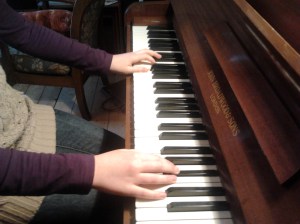
2012-02-12 12.53.52Mathematics, for instance, can be very beneficial to musicians in working out musical structure, how to combine rhythmic patterns and subdivide beats, and when analysing Lutosławski, Messaien and several other mathematically-aware composers. Maths is also excellent at a higher level for developing the kind of abstract thinking skills which many gifted musicians find comes naturally to them.

Languages can also be a very beneficial area of study. In the sense of being able to translate song lyrics written in other languages, or in reading tempo and expression markings in Italian, French, German etc, of course their usefulness is clear. However, learning languages properly also prepares the brain to order thought differently: each language reflects a mindset, a prioritizing of concepts and values, and this is useful when applying to interpreting music. Getting inside the syntax of music is a similar skill, and linguistic skills may well equip musicians to tune their ears and hearts to deeper elements of what a composer is saying.

2012-05-02 23.56.53History is another potentially-useful field of study since an awareness of historical context can inform musical interpretation. Similarly, social sciences such as anthropology may provide insights into a composer’s world and enable performers to better understand their musical world, reflecting as it surely does, its times and cultural contexts.

The list goes on: Science provides key thinking skills and ways of analyzing the world which are useful to the thinking musician; a good command of English is invaluable for musical criticism; Philosophy attempts to put into words many of the truths which music manages to convey without them; Physical Education tones the muscles required for performance… indeed it is hard to think of any subject which cannot be justified for inclusion in a school curriculum for its knock-on benefits to musical education.

So I urge Academy Trusts, Education Authorities, Headteachers, School Governors and the Secretary of State for Education not to restrict the curriculum by pushing non-arts subjects out. They are useful in developing students’ intelligence, nurturing skills which are of immeasurable use to musicians, and are quite likely to improve the performance of musicians of all levels.

***


I’m fed up of reading articles which try to justify the study of music only in terms of how it benefits intelligence and performance in other subjects. Music is worth studying in its own right, as part of growing as a human being, just as surely as other subjects are beneficial to human flourishing.

Only, obviously, less so than music…

The Tooth Fairy

The Tooth Fairy Is Only The Beginning

It was nearly out. Edward’s first wobbly tooth had been hanging by a thread for over a fortnight. He had really enjoyed prodding it with his tongue, wiggling it, relishing the slight pain as the sharp edge pressed into his gum… and yet the tooth held firm. It would almost be a shame when it actually did break loose. This was a once in a lifetime experience: never again would Edward lose his first tooth.

And then it happened, one evening as Edward was getting ready for bed. He had brushed his teeth without incident and was crawling on the floor looking for a book which had slid too far under his bed. The tooth fell out. Neither in a cascade of blood as he had expected, nor in an explosion of pain, but in a simple snap as the tooth broke free of the gum and plopped unceremoniously onto the carpet. Edward picked the tooth up and placed it under his pillow. When his mother came to kiss him goodnight he said nothing, preferring to announce his tooth’s loss in the morning when he would have a shiny golden one pound coin to show from the Tooth Fairy. Edward went to sleep.

***

Morning. Edward awoke and slid his hand under the pillow. Where his tooth had been, he felt something cold and hard. He brought it out and saw that it was indeed a one pound coin. He announced his news over the breakfast table and was very happy when he saw his mother and father’s surprise as they saw the gap in his teeth and his shiny one pound coin. Edward went around with a gappy smile all day.

A few days went by and Edward found himself one afternoon sitting in the garden in between things to do. His thoughts turned to the Tooth Fairy. How exactly did this system work? It can’t be anything to do with my parents, he reasoned, since they hadn’t even known about the missing tooth. So who tells the Tooth Fairy? Let’s think this through… what can the signal be? Edward thought, and thought… and reasoned, and reasoned…. then realised.

That night, Edward decided to put his theory to the test. He had reasoned that the important thing must be the pillow. Putting the tooth under your pillow must be the thing which summons the Tooth Fairy. So Edward had decided to conduct an experiment. After his mother had kissed him goodnight, he slipped his big toe under his pillow before he fell asleep.

***

Morning. Edward awoke and slid his hand under the pillow. Where his big toe had been, he felt something cold and hard. He brought it out and saw that it was a two pound coin. So the pillow was how it worked! It had worked with the Tooth Fairy, and now it had worked with the Big Toe Fairy. Edward practiced walking around with his newly reduced set of toes and found that with a bit of practice it was easy to do without one big toe, so long as you didn’t go too fast round corners. Anyway, there was obviously money to be made in this way, thought Edward, so what next?

That night, Edward slept with his elbow under the pillow.

***

Morning. Edward awoke and slid his hand under the pillow. Where his elbow had been, he felt something crinkly. He brought it out and saw that it was a twenty pound note. Edward gave a little whoop – at this rate he would be rich! Ah, but what about his elbow? Edward looked at his left arm and tried to bend it. It wouldn’t bend. He pulled up his pyjama sleeve and looked… there was no elbow in his arm! So the Elbow Fairy really had taken his elbow in exchange for the two pound coin. So, how to keep his mother and father from finding out… Well, Edward would still be able to write, and if was careful, it would be ages before anyone noticed his missing elbow. No, nobody would notice, thought Edward. Now, what else can I do without? Hmmm…

That night Edward slept with his bottom under the pillow.

***

Morning. Edward awoke and slid his hand under the pillow. Where his bottom had been, he felt something crinkly. He brought it out and saw that it was a fifty pound note! Edward laughed. This really was an easy way to make money. The Bottom Fairy was evidently even more generous than the Tooth Fairy, the Big Toe Fairy and Elbow Fairy.

Edward started thinking… so as the parts of the body got more significant, so did the money. Edward went over to the mirror and took a look at himself. He no longer had a bottom but he would be able to roll up a jumper and put it in his trousers to hide that. So what next? Edward took a look at what was left. He was slim and had long arms and legs… but a whole arm or leg was bound to be spotted by his parents very quickly. Selling off his fingers and toes one by one would probably only get him a few pounds before his secret was discovered. Hmmmm…. how could he make a lot of money… which part of the body would be most valuable?

That night Edward slept with his head under his pillow.

***

The following morning, Edward’s body lay in his bed. It did not move as it had no head to tell it to.

***

Edward awoke. He looked around. He was in a very strange place. There were lots of plants around, a sea of green illuminated by a riot of colourful blossoms. He yawned… then stretched his arms – but no! He could not feel his arms. He looked down at his body. It was not there. Edward looked around himself. Where was he? A very small, winged person flew up to Edward’s eye level.

“Hello,” said the very small, winged person, “I’m the Head Fairy.”
“Where am I?” asked Edward.
“In my dingly dell,” explained the Head Fairy, “which is where you will live too from now on. You are part of my collection.”
“But where’s the rest of me?” asked Edward.
“Well, did you put the rest of you under the pillow too?” asked the Fairy.
“No,” said Edward, sadly.
“Well, then.” said the Head Fairy, and flew off to check on the other heads in his collection.

***

And back in Edward’s bedroom, his mother found the rest of him, with no big toe, no left elbow, no bottom… and no head.

On the plus side, the Head Fairy had left seventeen bars of gold under Edward’s pillow, so she and Edward’s father were suddenly exceedingly rich, though sad of course to have a son with so many bits missing.

THE END

The Impossible Self-Transfiguration of Fryer Michael

20160731_002926

i. Shadow

i
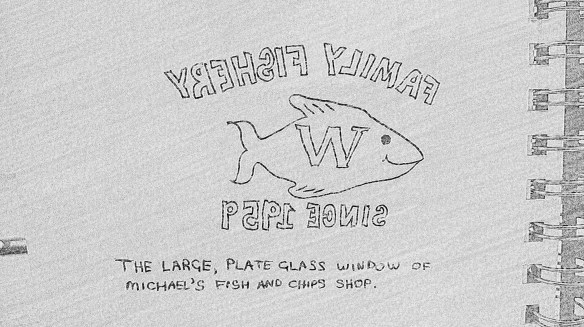
Michael Wilson stared through the large plate glass window and pondered Kirk Lane, gleaming in unaccustomed sunlight. Like his father, uncle and grandfather before him, Michael kept the shop open for Friday lunchtime all through the summer months at exactly the hours he’d inherited, even though few customers nowadays were after fish and chips for lunch on days like these. Had Kirk Lane been located at the seaside or in a touristy town, popular with day-trippers, his continuation of these opening hours would be more understandable, but on a hot, summer’s day in the backstreets of a Pennine town whose mills had long-since closed, and whose subsequent service industry businesses had also, for the most part, folded as austerity had bitten, very few of the remaining residents had enough income from their zero-hours contract jobs to spend on fish and chips for lunch on a Friday. But Michael was planning on retiring soon and he hadn’t the heart to abandon the family chippy just yet.

And yet, his was now a lonely life, especially with so few customers, even in the evenings. Occasionally his oldest friend, Luke, would pop in for a chat – Luke, whose corner shop had served the community for several decades before his retirement a few years ago. Their conversations would eventually and invariably turn to a familiar theme: neither of them had anyone to pass their family business on to.

In Luke’s case, his son, Mark, had gone off to university some twenty years ago and had never returned, but ended up as an engineering manager for a plastic extrusion mouldings company based in southern Spain. Michael, though, had no children. He and Louise had talked about starting a family, but decided to wait until Michael’s uncle retired and they were running the business themselves. They had suspected that if they’d had little ‘uns, Uncle John would use their young family as an excuse to linger on in charge into his seventies. And then the car crash which killed both Louise and Uncle John came along and Michael was left to run things on his own.

***
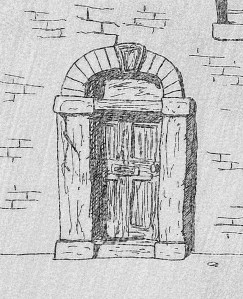
20160731_002106Michael was struck by how stark and strong the shadows were outside. The midday sun caught Kirk Lane straight down the middle, pretty much, since it ran north-south, causing the doorways to be largely shaded by the door frames and the shadows of the guttering to fall across the top half of the upper windows opposite. But there was nowhere to escape the sun’s glare.

Michael knew that Luke resented Mark’s success, “Dumb luck of that boy to work in an industry that isn’t being undercut by bloody India or China!” as Luke bluntly put it. But Michael also knew there was more to their rift than paternal jealousy and resentment. Mark had started in a very junior role in a plastics company based in Sheffield and had been promoted (though without a pay rise) after a whole swathe of more senior staff had been laid off due to financial problems at the company. He ended up managing a significant part of the operation which involved many different aspects of the industry and got to know how the market worked pretty well, so when, a few years later, a Spanish competitor was looking to employ someone experienced, inexpensive, young and with a decent understanding of the European market, Mark was just the man for the job. Now, in Spain for ten years and living with a local girlfriend with whom he had an eight year old daughter whom Luke had never met, Mark’s life seemed settled, happy, and probably as secure as anybody’s these days. He kept in touch with his dad now and again, but Mark’s success still left Luke under a cloud of regret: regret that this was not the happy ending for his son which he had hoped for and worked hard to achieve. Plan A was for Mark to inherit a thriving family business: a corner shop as merely the starting point for a chain of retail outlets, including things which Luke knew he could not fathom, but which he saw others of Mark’s generation doing well at – e-cigarette shops, mobile phone accessories – and that was his family’s way. Find a niche, employ family where possible to keep the money in the family and sell what people want. Luke would often tell Michael that he needed to diversify from the traditional fish and chip shop menu, to look at wider society for trends to follow, niches to exploit. But Michael had no interest.

There was something solid about Michael’s menu, something that grounded him. Perhaps it was simply that to change it on his own would seem disrespectful to Louise who’d always maintained that “Folk will always want fish and chips and the standard menu. There’s no need for fancy stuff: stick with the usual.” And so it was that the jar of pickled eggs, the jar of gherkins and the bottles of non-brewed condiment sat on the shelf behind the counter as they had since the 1950s. Cod, haddock, battered sausage, pies, fish cakes, spam fritters… the usual fare, together with gravy, curry sauce, baked beans or mushy peas were on offer. No need to innovate in this business, not at my time of life, had been Michael’s unwavering approach. Yet there was something in the air today, something about his sudden mindfulness of the sunlight and the shadows which made Michael rather thoughtful.

***

“You can batter and deep fry anything. Anything!” Luke had told Michael on more than one occasion. “Up in Glasgow, they deep fry black pudding, white pudding, pizza, Mars bars – anything.”. Whereas Luke had sounded impressed and even excited by this, Michael had merely shrugged, but now, as the shadows lengthened into the early afternoon, Luke’s words came back to him.

The sunshine and the shadows… sunshine like golden batter gave an aura to the run-down road outside. The deep shadows only highlighted the rosy glow further, so that Kirk Lane, depressed, unloved, largely abandoned Kirk Lane, was transformed. There was some kind of life, some kind of hope here still, mused Michael, something in and among the light and shade of the day. A curious sense of playfulness had entered Michael’s mind. He popped upstairs to his flat over the shop, returning a few minutes later carrying a couple of things from his kitchen. You can batter anything, eh? Hmm…
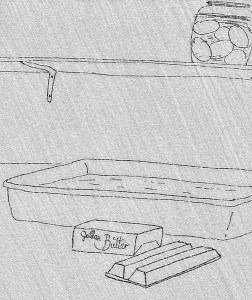
20160731_002204First, Michael battered a KitKat. The art was in the timing and the thickness of the batter, he reckoned: he had to ensure the batter was spread fairly evenly over the whole of the KitKat, then plunge it into the bubbling oil just long enough for the batter to get crispy. Of course, there was no need to actually cook the KitKat, so it was quite a different kettle of fish than frying… er… fish.

Next, Michael battered some butter. This had been an unopened packet in his freezer and Michael did wonder whether this would actually work at all, even though one of his regular customers, Florence Mitchell, had confidently told him that this was something which had already been done at a county fair somewhere in America. She’d seen it on the telly. Mind you, Florence was far from reliable as a source of information and had once told him that a man in Bolton had taught his ferret to answer the phone and swear at cold callers, and much as Michael wanted to believe this tale, he was quietly confident that it was not true. However, in this case he decided to play along with Florrie’s received wisdom, but he thickened his family recipe batter so it would be less runny than usual, but decided that the only course of action was to simply go for it and see what happened. The theory was that the batter should absorb most of the heat energy and have chance to cook before the frozen butter had time to completely melt. There was only one way to find out…

The result was a squishy battered brick, not the complete mess Michael’d feared. He tried a bit of battered KitKat which was satisfyingly crunchy (and the chocolate layer was really tasty in combination with the batter). For the battered butter, Michael decided that a plate was in order. And a fork. The battered butter brick yielded to the fork and broke off a golden, yellow, gently-oozing chunk, with crisp batter encasing the edge. Michael tasted it. And it was good. Exquisitely rich in flavour, outrageously laden with calories and combining salty sweetness with a clash of contrasting textures – this was a delight, thought Michael. You can indeed batter anything. Batter makes everything taste different. Perhaps batter makes everything better?

***

The afternoon light had changed. Usually, Michael would have shut up shop by now but with his adventure in experimental battering and deep frying, the time had flown by. The sun was now shining directly into the shop through its large, plate glass window. Michael was hotter than he could remember ever being. Sunlight shone directly onto the batter tray behind the counter. Does batter make everything better?
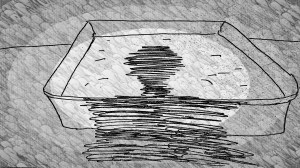
20160731_002503Michael took the batter tray and carried it over to the customers’ side of the counter and placed it on the floor, resting it against the counter in full sunlight. He turned the sign on the door round so it no longer said “Open” but rather said “Closed – even for Mickley’s Pies”.
Michael stood by the window so his shadow fell across the batter mix. He had no idea why he thought that what he was planning to attempt was a reasonable thing to do. Perhaps it was heatstroke, he thought. Let’s see if you can indeed batter anything, my friend, he said in his head to Luke…
Then Michael moved so that every part of his shadow moved across the batter tray.

And somehow, and he really did not know how, Michael managed in that sunlit, golden, suspended moment which seemed to sit both in and outside time, to entirely batter his own shadow, then throw it into the oil and deep fry it so that his shadow, and indeed everything which had cast shade on his life, his hopes and his future, was mysteriously encased in golden batter. And everything somehow now tasted better.

ii. Transfiguration

ii
Luke opened his front door, curious to know who was ringing his doorbell so late in the afternoon. He hadn’t made any online purchases lately so a courier seemed unlikely, and nobody else seemed to actually call round these days, not the Prudential, not even the Rington’s Tea man, or the Jehovah’s Witnesses. And Luke was astonished by what greeted him on the doorstep on several counts. Firstly, this was the first time in the course of a friendship which had lasted more than thirty years that Michael had ever come round to Luke’s home during daytime, uninvited. Years ago, Michael and Louise had been there as guests of Luke and his wife Pauline on a couple of occasions, but simply dropping by on the off chance was something which Luke did to Michael round at the chip shop, but Michael never reciprocated. The second cause of Luke’s surprise was Michael’s appearance, but Luke was hard pushed to say exactly what was odd about his friend. But odd was what he definitely was.

“Er, come in, Michael.” said Luke, who was feeling decidedly wrong-footed by the situation. Michael stepped inside and followed Luke through to the living room. “Something has happened to me, and I’m not sure it makes a lot of sense.” said Michael. There was an awkward pause. “I seem to no longer have a shadow.”

Michael had first noticed this as he’d walked along Kirk Lane – he cast no shadow on the road, on cars, or on the pavement. A strange sense of purpose had propelled him out of the shop and along Kirk Lane and then round the corner into Gordon Terrace to seek Luke, and somehow this seemed to have some kind of connection with what had happened to him earlier. Even when Michael had gone right into the full sunshine of the middle of the road, not only did he have no shadow, but when he turned his back to the sun, when he looked down at himself he could see that his front was unshaded, as if still lit by full sunshine. Indeed, it was this very effect which had so discombobulated Luke when Michael had first presented himself on his doorstep.

“This is… true… or seems so,” said Luke, “Have you had some kind of religious experience?”
“No… well… I had a highly calorific one and then I did something weird, but it wasn’t some kind of holy-moly thing. I seem to have done this myself.” explained Michael in a way which, frankly, explained nothing. He filled his friend in on the events of that day’s extended lunchtime.
“You look like someone who’s had some kind of revelation – like… when Moses went to get the Ten Commandments off God… and when Jesus went to chat to God while a few of his friends watched… they ended up all shiny with holiness. That’s what you remind me of. I always wondered what that actually looked like and now I can more easily imagine.” mused Luke, a lapsed Catholic who’d evidently taken something in at Sunday school many years ago.
“But this was not a vision, I didn’t go to heaven, though I’d tasted something unexpectedly divine just before… but that was deep-fried butter” protested Michael, “so it wasn’t God… it was my family’s own secret recipe fish batter and heaps of saturated fat that did this.”
“And yet,” said Luke, “the fact remains that you have a holy glow about you. There’s no darkness around you at all. It’s some kind of miracle – a sign or… er… well, it must be a sign of something, that’s all.”
“A sign? A sign of nothing I can see,” said Michael, “and all I am left with is my shadow encased in batter back in the shop, and I don’t really know what to do with it.”
“What does it look like?” asked Luke, “Is it like a full sized replica of you in batter?”
“No,” said Michael, “it’s just a weird, globby, mis-shapen lump of batter. I reckon I should eat it, y’know – seems wrong to chuck it, and I daren’t just leave it around. It’s weird… but… but it’s almost as if everything that’s gone wrong with my life is in it. I want rid… but the right way. Whatever that is. I need to think about that.”
“If this is something you need to do,” said Luke, “then you should not be alone while you work this out. I’ll come with you.” And so the two friends walked in the late afternoon sunlight back down Gordon Terrace where Luke lived and along Kirk Lane towards Michael’s fish and chip shop.

iii. Prophecy

iii
By this time, the local primary school had just finished. It was almost the end of term and children with parents and grandparents were streaming along Kirk Lane in the opposite direction to Michael and Luke. “Hi, Michael!” shouted a young mum by the name of Deborah – a neighbour of his whose son, Diesel, often banged on the fish and chip shop window as he walked past.

“Hello, Deborah,” said Michael in reply, and he continued to walk past her, keen not to be waylaid. “Mummy, look – look!” yelped Diesel, pointing to Michael, “He’s got no shadow like he should of.”
“Should have,” corrected Deborah, “and everyone has a shadow, look…” And as she looked, she stopped. Her son was quite correct. “We did shadows at school ages ago,” explained Diesel, “and in sunshine it works best. You just need the light to come from somewhere and something for the shadow to land on. You can’t escape shadows, even if you run right fast. How is Mr Wilson doing that?”
Michael Wilson had no idea and neither did Deborah nor Luke.
How…?” asked Deborah.
“I don’t know,” said Michael, “but I do know that I tried to batter and fry my own shadow and somehow I managed it. Diesel, what you learned about shadows is quite right. I know for a fact that I couldn’t run from my shadow, and if I’d tried to shine a different light into it, the shadow would simply change direction or appear somewhere else, but encasing it in a traditional fish batter and deep frying it does seem to have done the trick. But I don’t know why or how.”

By this point, other mothers and small people had taken an interest and there was a small crowd gathering. They all had questions and Michael was feeling self-conscious and uneasy about all this attention. He just repeated a summary of what he’d told Deborah, “Look! Shadows are a fact of life. There’s light and shade in all of us. You can’t run from your shadows, or shine light onto them to get rid of them – at least, not forever. But you can trap them in tasty batter, apparently. I don’t know how, but you can. So there has to be hope, doesn’t there?” And with that, he strode off to the fish and chip shop with Luke. But the conversations continued and discussions started… could the Wilson family batter recipe somehow have magical properties, capable of destroying darkness in all its many forms, physical, metaphysical, spiritual?

iv. Revival

iv
Luke and Michael stood in the chip shop as the late afternoon sun beat through the window and they stared at the deep-fried shadow. “It’s not as big as I expected,” said Luke.
Michael shrugged, “But still a fair-sized bit of batter to eat, if that’s what I decide to do.”
“Fair enough.” Luke agreed. It was about the size of a football, which is much, much more batter than it is wise to eat in one sitting. The two of them stared at the batter some more. They pondered. There was much silence, punctuated by occasional sighs and deep breaths.
“So, are you going to eat it, hide it, put it on display? Any idea?” asked Luke eventually.
“Come back after the evening frying’s over,” said Michael, “I reckon I need to just get on with the Friday night fry to clear my head then work it out.”  So Luke left, promising to return later that evening as Michael began to get the shop ready for Friday teatime.
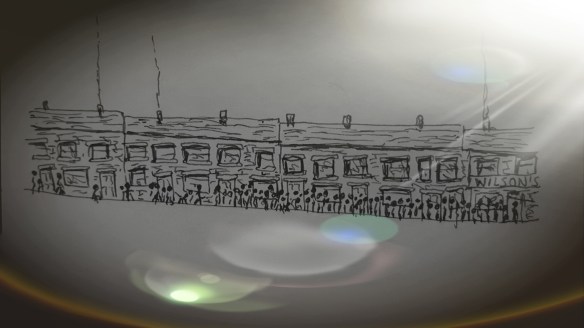
20160731_002631To his astonishment, when the time came to open up, a large queue had formed outside. People who had never darkened his door before were there, along with customers he usually only saw occasionally and the queue was huge. In fact, even before serving the first customer, Michael phoned Amy, a local lass in her early twenties who had occasionally helped on Saturdays as a teenager, and asked her to come in to serve while he fried.

It seemed that word had spread and the tale of Michael Wilson’s curious transfiguration and his words of hope of life free of shadows had struck a chord. The whole community wanted to be free of their shadows, to lead lives full of light and void of darkness – free of all those kinds of shadow which can never be run away from or dispelled with vain attempts to shine a jolly light into them. The community was thirsty for enlightenment and Michael and Amy kept frying until they had entirely run out of batter, fish, chips and even mushy peas and were forced to close the shop, even though there were still people waiting to be served.

“Phew!” said Amy, “I’ve never known it like that before.”
“Me neither,” said Michael, “that was as busy as any night in the old days when my granddad ran the place, and back then nearly everyone had a fish supper on Friday.” He looked around the shop. Even the pickled egg jar was depleted… But he couldn’t see the deep-fried shadow where he’d left if over by the fridge.

“Amy,” he asked, “did you see a big ball of batter over by the fridge earlier?”
“Aye,” Amy replied, “I broke it up about twenty minutes into the shift – everyone was asking for bits on their chips, so I hacked that batter up and kept it in the warmer as there was such a run on it. Was that OK?”

Michael paused, then answered, “That’s fine, Amy.” knowing full well it was not, but what could he do? Actually, in food hygiene terms alone, Amy was in the wrong to take apparently discarded batter and serve it, but Michael knew it had been similarly remiss of him to leave the thing in a food preparation area in the first place. But somehow he had a sense of peace about the shadow now.

v. Ascension

v
Michael walked down the middle of Kirk Lane as the sun was setting. Luke was walking from the opposite end of the road towards him, and as he approached noticed that Michael was not only free of shade and shadow, was not only strangely radiant and translucent, but seemed to be actually fading, with the texture of the road, potholes and all, clearly discernible through him. As the two met, Luke could see that his friend looked happy. No, not happy: something deeper – he looked to be at peace.

“Michael, you’re fading – I mean I can see through you. What’s going on?” asked Luke.
“I think that right now, everyone is eating the shadow batter in houses, in the park, the graveyard… all round here. Amy mixed it in with the orders tonight – she didn’t know what it was. Somehow my shadow being deep-fried and eaten is having some kind of effect on me. I really do think a great weight is being taken from me. And, you know what? I have realized there is something I need to tell you as I disappear, Luke, something I always intended to say, but somehow never have done, but I can say it now with complete sincerity before I disappear completely… you see…”
“No, you really don’t to say anything,” said Luke. “I know.”
“What?” said Michael.
“The crash,” said Luke, “I feel it. I know. It’s like you have somehow already told me. You’ve forgiven me, haven’t you? All these years of polite friendship, a shared sense of loss, but we both knew… There was one thing that could never be undone, one fact we never confronted, never spoke about. A shadow has hung between us. But it is gone, isn’t it? I… I know you have truly forgiven me.”

Michael simply smiled, nodded and… disappeared completely. Luke could see him no longer.

And as Luke walked back to Gordon Terrace, he sobbed, lifted of the burden of the deaths of Michael’s wife, Louise, of Michael’s Uncle John and of Luke’s own wife, Pauline who had been in the passenger seat right next to him as he’d taken the corner far too fast, crashed through the small wall and rolled the car down the hill. As soon as he got home, Luke picked up the phone and left a message on Mark’s voicemail before ringing the travel agent in Bradford he used to use for family holidays and arranging a flight to Barcelona on Sunday. He could face his son now.

Somehow, by whatever miracle the Fryer of Kirk Lane had performed, Luke was finally able to forgive himself and walk out of the shadows. As his friend had disappeared, Luke had miraculously forgiven himself, just as surely as Michael had forgiven him. Luke walked on in the light.

20160731_001937

Luke 11:2-4
He said to them, ‘When you pray, say:
Father, hallowed be your name. Your kingdom come. Give us each day our daily bread. And forgive us our sins, for we ourselves forgive everyone indebted to us. And do not bring us to the time of trial.’

New Revised Standard Version

Click here for some ideas for small groups, or to start you off thinking about this story 

Creative Commons License
This work is licensed under a Creative Commons Attribution-NonCommercial-NoDerivatives 4.0 International License.

Ellen – The Girl Made of Edam

Chapter 1 – The making

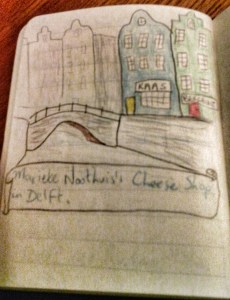
image (3)Once, or possibly even twice upon a time, there lived a cheese-maker. Her name was Magda Melick and she lived with her husband Marek Melick in a flat above her cheese shop in the Dutch city of Delft. She made the very finest cheeses of all kinds and was a very successful businesswoman who had become very rich on the proceeds of all her delicious cheeses. Magda and Marek Melick had everything they desired. Their flat had every modern convenience. They had a lovely sailing boat which they took out on the surrounding canals and lakes on Sundays when the cheese shop was closed. Their lives were very comfortable and happy. However, Magda and Marek lacked one thing which, they believed, would have made their happiness complete: they had no children of their own and were now too old to start a family.
One day, Magda told Marek that she had a plan. “I have far too much milk today. Wim the dairyman delivered far too much this morning. I was thinking that, since we cannot have a child of our own, I could make us a daughter out of Edam cheese with the spare milk.”
Marek knew better than to question the judgement of his clever, cheese-making wife and so nodded politely, adding “Sounds wonderful, my dear.”, though privately he wondered whether to book them both a long holiday as his wife seemed to be going a bit doolally and in need of a break. Magda Melick set to work immediately. She worked through the night and the following day creating a new mould in which to pour the cheese as well as a special pulley system for lifting the unusually large and heavy child-sized cheese she had in mind, then started on the cheese-making itself. Having prepared the cheese in a huge, wooden bath and poured it into the girl-shaped mould, Magda pressed it (twice) and left it to float in brine, then let the cheese dry before coating it in bright red paraffin wax. She then locked it away in a special room of its own in the cellar. All this had taken place over the course of several days alongside Magda’s usual cheese-making, so she was absolutely exhausted by the end of the process. She slept well that night. All that was left was to leave the cheese-child to mature in the cellar.

* * *

Two months passed by. Then, quite early one morning, Marek Melick was woken from a deep sleep (featuring a vivid dream about a salami sandwich) by a dull, thudding noise coming from downstairs. He was frightened so he woke his wife up. “I think there is someone downstairs in the shop!” he hissed.
Magda shot out of bed, her nightie (with pictures of gherkins on) whirling around her legs as she grabbed her shotgun from under the bed, then ran downstairs. Marek put on his dressing gown (with pictures of giraffes on) and followed her. Down in the shop there was no sign of anyone, nor in the cheese-making room out the back, but the thudding was much, much louder now and was clearly coming from the cellar. Magda Melick opened the cellar door, turned the light on, cocked her shotgun and set off down the stairs. Marek grabbed a large soup ladle and followed his wife.

Chapter 2 – The meeting

Once in the cellar, Magda and Marek could hear and see exactly the source of the noise. The door to Magda’s special section of the cheese-cellar (the room which currently housed her experimental cheese-child) was juddering and quaking as something persistent and evidently either very heavy or very strong was thumping against it from the other side.
“Wait!” shouted Magda. The thudding stopped. “I’m opening the door.” Magda put her shotgun down and lifted the latch.

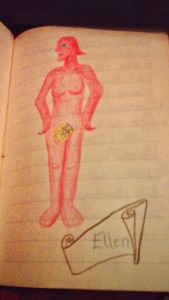
The door opened slowly, revealing a shiny-skinned, bright red woman as tall as Marek but far less hairy. And stark naked. Marek blushed and didn’t know where to look. As I am sure you know, Edam takes two months to mature in order to be ready to eat, and so it was that, over the two months in the cheese-cellar, Magda’s cheese-child had also matured into a fully-grown young woman as well as a perfectly mature Edam.

“Hello,” said Magda, “My name is Magda Melick and I am your mother. I made you. This is your father, Marek.”
“And what is my name?” asked the young lady made out of Edam.
“Ellen.” said Marek who had given this some thought over the previous two months. “Yes, Ellen is your name.” agreed Magda.
They led Ellen Melick out of the cellar and into their kitchen. She sat at the kitchen table with Magda as Marek mashed a pot of tea. “So, what is this place?” asked Ellen.
“It’s the kitchen where we make and eat our meals.” explained Magda.
“What are those things over there?” Ellen enquired.
“Those are pans which we use to heat things in on the stove.” said Marek.
“And those?” Ellen indicated the hanging utensils.
“Ladles and serving spoons to serve soups, stew and casseroles with, tongs to turn sausages and chops with, that kind of thing.” said Magda. Marek, reminded by this, replaced the largest ladle he had armed himself with earlier.
Ellen got up from the table and walked around the kitchen, picking up or pointing out various objects inquisitively.

image“This?”
“A food mixer.”
“These?”
“Glasses to drink from.”
“And this?”
“A cheese-grater.”
“This thing?”
“A fondue to melt cheese with so you can dip things into it to eat.”
“What’s this for?”
“It’s a cheese knife.”
“And this?”
“A cheese board – it’s a wooden board for cutting cheese on.”

At this point, Marek poured the tea. “So,” asked Ellen, “why do I look different to you two if you’re my parents?”
“Well,” explained Magda, “Marek and I are humans and you were made by me. You weren’t born like a human child. We’re made differently to you.”
“Right,” wondered Ellen, “so… what are you made out of?”
Magda thought for a moment, “I suppose humans are made out of bones, blood, skin and meat.”
“And did you use those things to make me, too?” asked Ellen.
“No,” said Magda, “You are made out of cheese. The finest Edam cheese with skin of paraffin wax.”
“I see.” said Ellen.

After they had all had a cup of tea, Ellen told her parents that she was feeling tired and needed a nap. She was led up to the flat where Marek prepared their guest bedroom. Ellen put on one of Magda’s nighties (one with pictures of windmills on) and went to bed for a sleep.

Chapter 3 – The realisation

Marek was in the shop serving a customer when a piercing scream came from the flat upstairs. It was so loud and piercing that he dropped the fine lump of Gouda he’d been showing the customer. Magda in the cheese cellar also heard the scream. They almost bumped into each other at the foot of the stairs as they ran to find out why Ellen was distressed. They arrived in Ellen’s room to find her sitting bolt upright in bed. As Magda approached Ellen, arms outstretched to give her cheese-daughter a comforting hug, Ellen shrank away from her and scuttled off the bed into a corner of the room, grabbing a chair and holding it up with the legs pointing at Marek and Magda to ward them off.

“What on earth is the matter, my darling?” asked Magda, her voice trembling in alarm, “There’s no need to be afraid: we’re here now.”
“It’s you I’m afraid of!” sobbed Ellen. “I had a dream where I was peeled of my lovely, red, shiny skin and then grated and cut up on your wooden cheese-board, then melted in a fondue. It was horrible! And now I’m awake I’ve realised the truth: you created me to eat me. That’s why you made me out of cheese. All those things in the kitchen make sense now: the grater, the knife, the cheese-board, the fondue – you are going to use them all on me. You’re going to torture and eat me!”

And with that, Ellen hurled the chair at the bedroom window, smashing it completely, then leapt after it, falling two storeys onto the street below. She ripped off the windmill-emblazoned nightie and stood, defiantly in the street and sang:

“I shall never be fondue
I shall never be in you.
I roll faster than you’ll chase me,
I will out-roll all who race me.”

As soon as her song had ended, Ellen curled up into a shiny, red ball and rolled at lightning speed along the side of the canal and off into the side-streets of Delft. Her parents looked on, dumbstruck, from the bedroom window.

Chapter 4 – The nibblers

In Delft market square, a cat was licking its bottom. Out of the corner of its eye it saw a blur of red whizzing across the cobbles.
“Oi!” yelled the cat.
The red blur came to a stop and stood up. It was, of course, Ellen.
“What’s up, kitty?” she asked.
“I was just curious as to what you were,” purred the cat, “and my nose tells me you are made of Edam. Delicious, creamy Edam to which I am quite partial. Might I have a finger or toe to nibble on, do you think?”
“Certainly not!” replied Ellen, running away and, as she curled up into a ball once again, singing:

“I shall never be fondue
I shall never be in you.
I roll faster than you’ll chase me,
I will out-roll all who race me.”

as she zipped off out of the market place.

***

A rat was hiding beneath one of Delft’s many canal bridges when it heard a curious rumbling unlike any bicycle or pedestrian it had ever heard cross the bridge before.
“Hey!” exclaimed the rat, “what’s that?” as it scampered up onto the bridge itself. Ellen, whose rolling was the source of the curious rumbling, stopped and uncurled herself. “May I help you?” she asked the rat.
“Well I was just wondering what the noise was,” explained the rat, “but looking at you I can see that you are simply a huge truckle of cheese which explains it. Occasionally cheese does get rolled across my bridge, but never one as magnificent as yourself. Might I have a quick nibble of you, now I know what you are?”
Ellen was, naturally, affronted by this suggestion and, as quick as single cream drips down a strawberry, she curled up into a ball once more, singing:

“I shall never be fondue
I shall never be in you.
I roll faster than you’ll chase me,
I will out-roll all who race me.”

and swooshed off towards the edge of the city.

* * *

On the verge of a road just outside Delft, a hedgehog was chomping on a slug. The slug was not desperately happy about this but could not be bothered to complain as he was, as usual, feeling quite sluggish. Up the road trundled Ellen, whizzing along as a red blur, past the hedgehog and slug and into a huge field of orange tulips.
“Er…. um…. ‘Scuse me…” said the slug, lethargically.
But he was too late to attract Ellen’s attention and the hedgehog carried on eating him. Take note, dear reader: one does tend to miss out on all sorts of interesting things if one is too sluggish.

Chapter 5 – The tulip

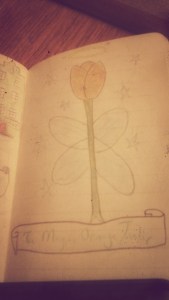
image (2)Meanwhile, in the tulip field, an orange tulip began to sing, “E-llen! E-llen! Co-me to meeeee! E-llen!” in a lovely, rich, low-bass voice. Unlike the slug, the tulip did succeed in attracting Ellen’s attention. She slowed down and rolled over towards the part of the field the singing seemed to be coming from.
“Who’s that?” enquired Ellen.
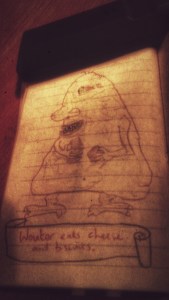
“I’m a magic, orange tulip.” explained the magic, orange tulip.
“Er… I’m not being funny, but which one are you?” asked Ellen. Being in a field of nine hundred and eighty thousand, five hundred and sixty four apparently identical, orange tulips didn’t make identifying the source of the voice at all easy.
“I’m the one with the shimmering, sparkling, magic sort of stuff coming out of my flower and the yellow halo hovering above me” boomed the tulip in his gruff, fruity voice.
Now she knew this, it was embarrassingly obvious to Ellen which tulip was the enchanted one. The flickering, sky-blue wings halfway down the tulip’s stem were a dead give-away too.
“How do you know my name?” wondered Ellen.
“You are a magical creature like me – I sensed you,” explained the tulip, “and I wish to help you fulfil your true destiny.”
“My destiny?”
“Yes, the purpose of your life. The meaning of your existence. I can use magic to make your destiny come true right away, but I need you to stand quite still while I say the spell which will make everything clear to you. And you will have to ask me to do the spell or the magic won’t work. I can’t do it without your permission. Do you want me to do this?”

Ellen thought. She couldn’t just keep rolling on forever. And, so far as she knew, there were no other Edam-people like her anywhere in the world. The tulip’s offer did seem to make sense…
“OK, do the spell.” she said.

The magic, orange tulip fluttered his wings and uprooted himself from the ground, his magical, sparkly aura shimmering all around him. He rose until he hovered above Ellen Melick’s head then started his magical incantation:

“Fanakapan, Fanakapan!
Lia-moggle-binkle-bonk!”
Suddenly, Ellen was whisked up in a tornado and shrouded in purple clouds. Out of the sky flew hundreds of small, brown circles and squares. A ladybird perched on a nearby tulip noticed that these circles and squares appeared to be crackers – the biscuity kind of cracker, that is, not the sort you pull at Christmas. These swirled around then were sucked into the swirling vortex of purple smoke. There was a blue flash and a sudden explosion from within the tornado. The purple cloud dispersed as quickly as it had formed and, from within the tornado, cheese and biscuits cascaded to form a huge, delicious hill in the middle of the field, crushing about two hundred and eighty two thousand, nine hundred and fifty three orange tulips beneath it. The magic, orange tulip had also undergone a sudden transformation, revealing its true identity.

image (1)The orange tulip had been merely a cunning disguise for Wouter the troll who loved cheese and biscuits for tea and who now had the most massive pile of Edam on crackers there had ever been. The ladybird thought he was a greedy, wicked, cruel and dishonourable creature for playing such a trick on Ellen. And Wouter would not only have agreed with the ladybird, he would have taken this opinion as a massive compliment as trolls pride themselves on being greedy, wicked, cruel and dishonourable.

So that was the end of Ellen.

Epilogue – The confession

Baldric and Barbara Bakker were entertaining two of their oldest friends. They had known Magda and Marek Melick since childhood and had invited them around for a meal that evening. Magda had seemed rather upset on arriving at the Bakkers’ home and Barbara had soon persuaded Magda to tell them what was bothering her. Magda told the Bakkers everything: all about creating Ellen, Magda’s delight in seeing her come to life and then the awful experience of seeing Ellen’s terror of her and her kitchen utensils and her dramatic exit from their flat into the streets of Delft. Magda and Marek had scoured the streets for hours afterwards seeking Ellen but to no avail. They still had no idea what had become of their cheese-daughter and had found the whole business very dispiriting.

Barbara and Baldric were very kind and sympathetic. Baldric uncorked a nice, old bottle of red wine and poured them all a glass.
“I do know how hard this must be for you,” said Baldric as he handed Marek and Magda their glasses of wine, “and I can imagine that having a cheese-child so briefly and then losing her must be even worse than having never had her at all.”
“Yes,” smiled Magda, “that’s it exactly. Oh, I’m so glad we told you Baldric! To have such wise friends… I thought nobody else in the world would believe us, much less understand how we feel.”
“Well,” continued Baldric, “Barbara and I, as you know, we also have never had children of our own. But…”
Baldric faltered as he spoke and looked across at Barbara. Barbara reached out and squeezed Baldric’s hand.
“But,” continued Barbara, “these enchanted children made out of foodstuffs… they never really work out for the best. You know that, before he retired, Baldric was a baker, just like his father before him? We had that shop on the corner of the market square – you remember? Well, Baldric’s biscuits were particularly popular, something of a speciality of which he was, rightly, proud. And one day, Baldric had a batch of gingerbread left over, and so…”

THE END

Creative Commons License
This work is licensed under a Creative Commons Attribution-NonCommercial-NoDerivatives 4.0 International License.